

Client Alerts / 22 October 2026
Key Insights on Construction Services Business Licensing and Foreign Investment Requirement Updates


I. Brief
The construction services business in Indonesia primarily operates under the governance of Law No. 2 of 2017 on Construction Services as amended by Law No. 6 of 2023 (“Construction Services Law”) and Government Regulation No. 2 of 2022 on the Impelmenting Regulation of the Construction Services Law as amended by Government Regulation No. 14 of 2022 (“GR 2/2022”). As like the majority of business sectors in Indonesia, the licensing of construction services business is centralized under the Minister of Investment and Downstreaming / Head of Investment Coordinating Board (Badan Koordinasi Penanaman Modal – “BKPM”) Risk-Based Online Single Submission (“OSS RBA”) system.
As part of the efforts to reinforce the risk-based business licensing framework, the Government of Indonesia has issued the Government Regulation No. 28 of 2025 on the Implementation of Risk-Based Business Licensing ("GR 28/2025"), along with its implementing regulation, the BKPM Regulation No. 5 of 2025 on Guidelines and Procedures for the Implementation of Risk-Based Business Licensing and Investment Facilities through the Electronic Integrated Business Licensing System (Online Single Submission) (“BKPM Reg 5/2025”). The issuance of GR 28/2025 and BKPM Reg/2025 formally revokes and replaces the Government Regulation No. 5 of 2021 (“GR 5/2021”) and BKPM Regulation No. 4 of 2021 (“BKPM Reg 4/2021”).
In light of the above regulatory developments, the Ministry of Public Works ("MoPW"), as the technical authority responsible for administering business licensing in the construction services sector, has also updated its implementing regulations governing the risk-based business licensing regime. Accordingly, the MoPW issued Minister of Public Works Regulation No. 6 of 2025 on Business Activity Standards and/or Product/Service Standards, Supervision, and the Imposition of Administrative Sanctions in the Administration of Risk-Based Business Licensing in the Public Works Sector ("MoPW Reg 6/2025"), which formally revokes and replaces Minister of Public Works and Public Housing Regulation No. 6 of 2021 on Business Activity Standards and Product Standards in the Administration of Risk-Based Business Licensing in the Public Works and Public Housing Sector ("MoPW Reg 6/2021").
In light of this regulatory development, the following sections highlight key insights on updates to the business licensing regime applicable to the construction services business.
II. Construction Services Business Entities and Types of Contruction Services
As a refresher, construction services business activities in Indonesia may be undertaken throughseveral types of legal entities, namely:
- National construction services business entity (Badan Usaha Jasa Konstruksi Nasional– “BUJKN”), which is a limited liability company established and wholly owned by Indonesian citizens and/or fully domestic-owned Indonesian legal entities;
- Foreign investment construction services business entity (Badan Usaha Jasa Konstruksi Penanaman Modal Asing – “BUJK PMA”), which is an incorporated joint venture between a BUJKN and a foreign construction services business entity or other BUJK PMA; and
- Foreign construction services business entity representative office (Kantor Perwakilan Badan Usaha Jasa Konstruksi Asing “KP BUJKA”), which is a representative office established by a foreign construction services business entity seeking to conduct construction activities in Indonesia without incorporating a BUJK PMA.
Each entity type set out above is subject to distinct regulatory requirements and operational scopes under Indonesian investment and construction laws.
Further, under the Construction Law, construction services are categorized into three types of services as follows:
- Construction consultancy services – which encompasses all or part of the activities including assessment, planning, design, supervision, and management of the construction implementation of a building.
- Construction work services – which encompasses all or part of the activities that include construction, operation, maintenance, demolition, and reconstruction of a building.
- Integrated construction services – which is encompasses the provision of both construction work and construction consultancy services in an integrated manner (e.g. EPC).
III. Key Insights
a. Foreign Investment Requirements
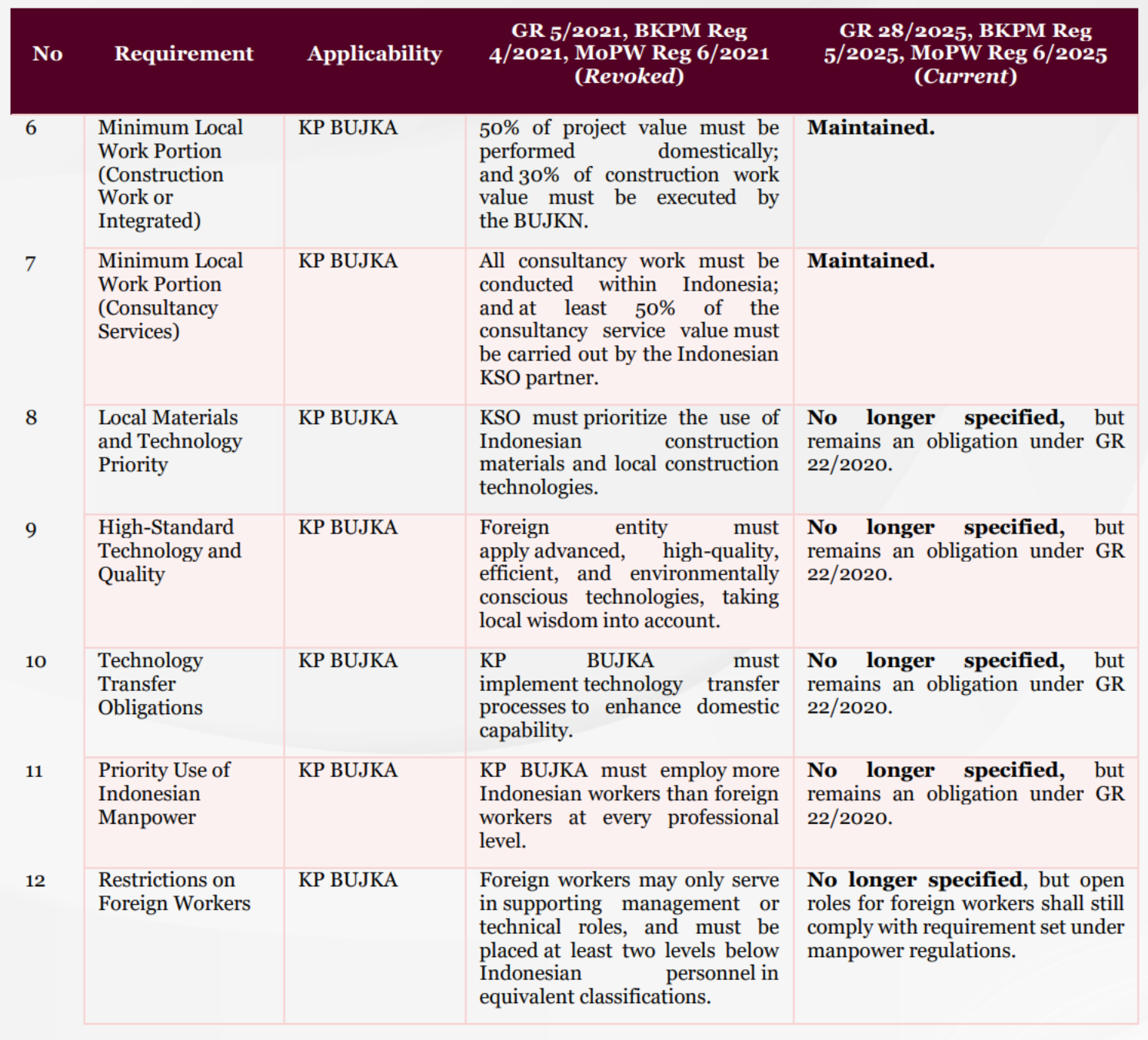
With respect to foreign investment requirements applicable to the construction business entities, whether in the form of a BUJK PMA or a KP BUJKA, we set out below comparison on the key requirements set out under the previous regime (GR 5/2021 and BKPM Reg 4/2021) and the current applicable regulations (GR 28/2025 and BKPM Reg 5/2025):
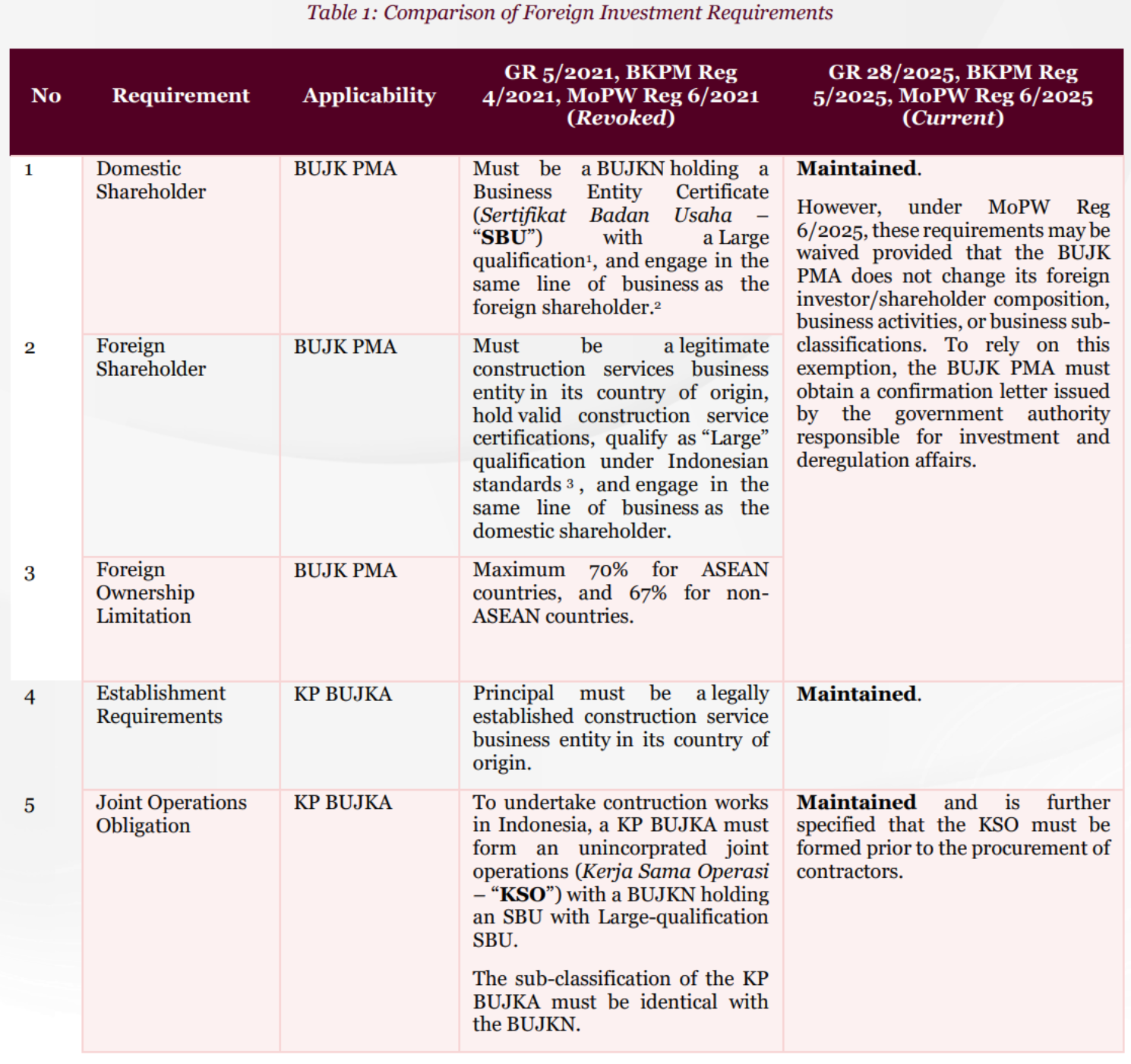
- A qualification relates to the scale and capacity of the construction business, and is assessed from the financial capacity, experience, technical personnel, equipment ownership of the construction services business entity. A construction services business entity may be qualified as small, medium or large. The larger and more complex the projects the construction services business entity is eligible to undertake. As for the criteria for a ‘Large’ qualification. Please refer to section III.c. below.
- The qualifying criteria for the ‘same line of business’ is not clearly defined under GR 5/2021 and BKPM Reg 4/2021. However, this is commonly understood as having the same construction services business sub-classification.
- Please refer to section III.c. below for the criteria for a ‘Large’ qualification.
b. Applicable Licenses
The primary OSS RBA licenses for construction service business entities remain unchanged under GR 28/2025 and BKPM Regulation 5/2025. Since most construction service activities fall within the “medium-low” to “medium-high” risk categories, the applicable OSS RBA licenses continue to consist of a Business Identification Number (Nomor Induk Berusaha or “NIB”) and a Standard Certificate. Regarding supporting business licenses, GR 5/2021 previously set out licensing requirements for construction sector participants, which included the Construction Business Entity Certificate (Sertifikat Badan Usaha or “SBU”), the Construction Work Competence Certificate (Sertifikat Kompetensi Kerja or “SKK”), and the registration of a KP BUJKA. However, GR 28/2025 removes the reference to KP BUJKA registration but maintains SBU and SKK. Apart from the changes noted above, the detailed regulatory framework governing construction business activities, including requirements relating to SBU, SKK, and classification structures, remains the same following the issuance of GR 28/2025. As of current, these matters continue to be primarily governed by: (i) GR 22/2020; (ii) MoPW Reg 6/2025; and (iii) Minister of Public Works and Public Housing Regulation 8 of 2022 on Procedures for Implementing the Fulfillment of
Apart from the changes noted above, the detailed regulatory framework governing construction business activities, including requirements relating to SBU, SKK, and classification structures, remains the same following the issuance of GR 28/2025. As of current, these matters continue to be primarily governed by: (i) GR 22/2020; (ii) MoPW Reg 6/2025; and (iii) Minister of Public Works and Public Housing Regulation 8 of 2022 on Procedures for Implementing the Fulfillment of Construction Service Standard Certificates to Support Business Licensing for Construction Service Providers (“MoPWH Reg 8/2022”).
c. Large Qualification
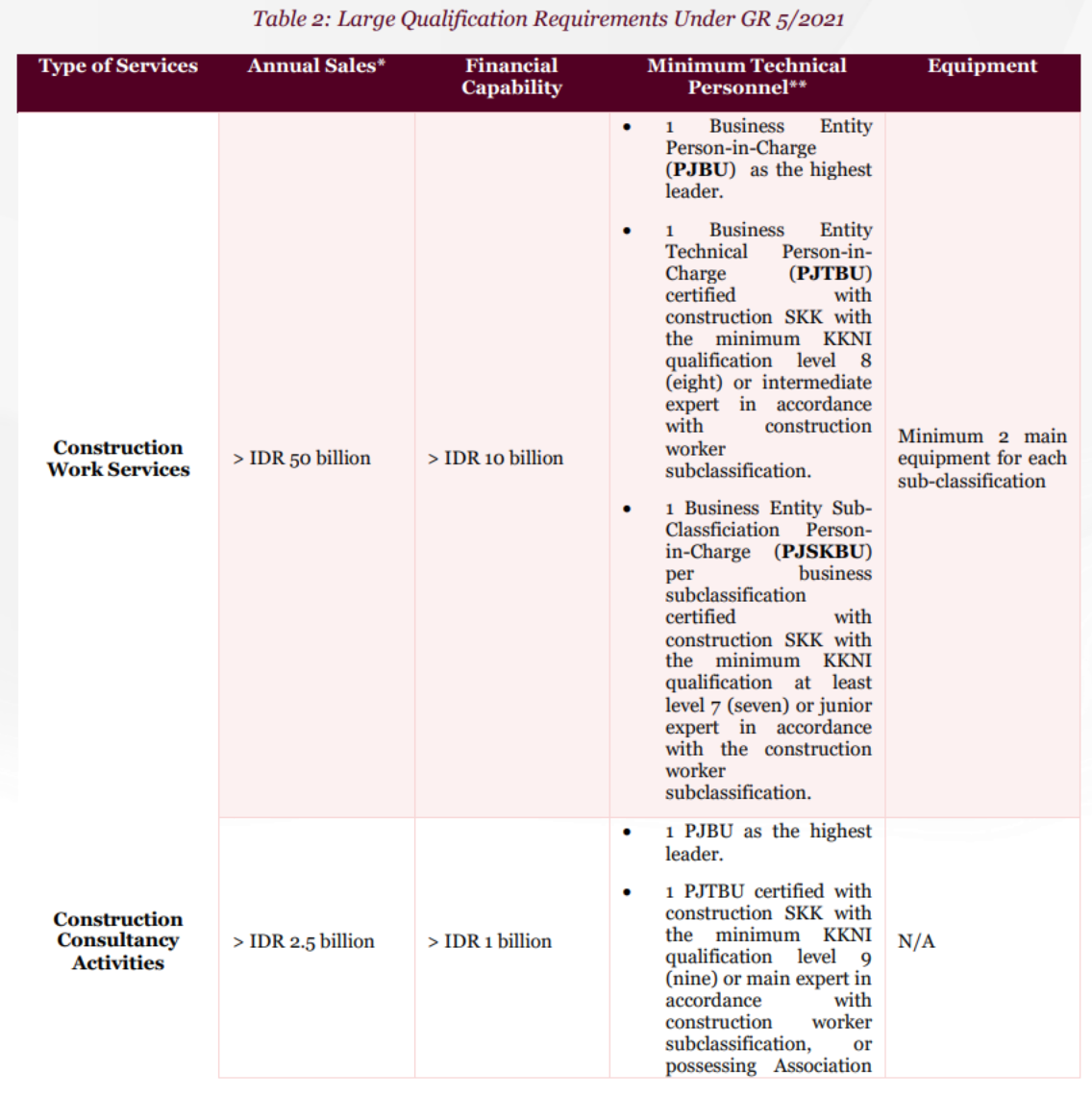
Requirements As noted in Part III.a (Foreign Investment Requirements) above, a BUJK PMA and a KP BUJKA are subject to a construction services business entity ‘Large’ qualification requirement. A qualification relates to the scale and capacity of the construction business, and is assessed from the financial capacity, experience, technical personnel, equipment ownership of the construction services business entity. A construction services business entity may be qualified as small, medium or large. The larger and more complex the projects the construction services business entity is eligible to undertake.
MoPW Reg 6/2025 sets out in detail the criteria that must be fulfilled in order for a construction services business entity to qualify for a ‘Large’ qualification, as can be seen in the table below:
Notes
*In respect of the Annual Sales qualification requirement:
- For a KP BUJKA, the initial certification application is assessed based on the construction work experience of the founding foreign construction services company.
- For a BUJK PMA, the initial certification application is assessed based on the construction work experience of the founding construction services companies (both domestic and foreign).
**In respect of the Minimum Technical Personnel qualification requirement, for a KP BUJKA, the PJBU must be an Indonesian national. If the PJBU position cannot be held by an Indonesian national, the KP BUJKA is required to appoint an Indonesian national as the PJTBU.
IV. Types of Services
Undertaken Consistent with the framework under GR 22/2020, a construction services business entity is generally restricted from engaging in more than one category of construction services business. Accordingly, a construction services business entity that is licensed to undertake one category of construction services (i.e., construction consultancy services, construction works, or integrated construction works, as described in Section II above) may not simultaneously undertake another category of construction services, except as expressly permitted under the prevailing regulations.
In this regard, MoPW Reg 6/2025 further provides that:
- A construction services business entity engaged in construction consultancy services is prohibited from engaging in construction works and/or integrated construction works.
- Conversely, a construction services business entity engaged in construction works and/or integrated construction works is prohibited from engaging in construction consultancy services.
- A construction services business entity engaged in construction works that intends to undertake integrated construction works must establish a KSO with a construction services business entity engaged in construction consultancy services. In such KSO for the provision of integrated construction works, the construction services business entity engaged in construction works must act as the lead member of the KSO.
V. Conclusion
The enactment of GR 28/2025, BKPM Reg 5/2025, and MoPW Reg 6/2025 introduces several structural and administrative adjustments to the regulatory framework governing construction services in Indonesia. However, the core substantive requirements applicable to domestic and foreign construction business entities remain largely consistent with the previous regime under GR 5/2021, BKPM Reg 4/2021, and MoPW Reg 6/2021. As such, the practical landscape for foreign investors operating through BUJK PMA and/or KP BUJKA remains broadly unchanged.
Although the latest regulatory reforms do not introduce significant substantive changes to the legal framework governing construction services, it is highly advisable for construction companies to reassess whether their existing licensing, certifications, and operational structures remain fully compliant under the updated regulatory regime. Given the evolving implementation of Indonesia’s risk-based licensing system and the increased integration between OSS and sectoral regulators, early legal and regulatory reviews can help identify compliance gaps, avoid disruptions to ongoing projects, and ensure readiness for future licensing and supervisory requirements.
We will continue the development of this topic. Should you have any queries on this topic, please reach out to our key contacts:
DISCLAIMER: This publication has been prepared by Corra Legal for educational and informational purposes only. The information contained in this client alrert is not intended and should not be construed as a legal advice. Due to the rapidly changing nature of law, Corra Legal makes no warranty or guarantee concerning the accuracy or completeness of this content. You should consult with an attorney to review the current status of the law and how it applies to your circumstances before deciding to take any action.